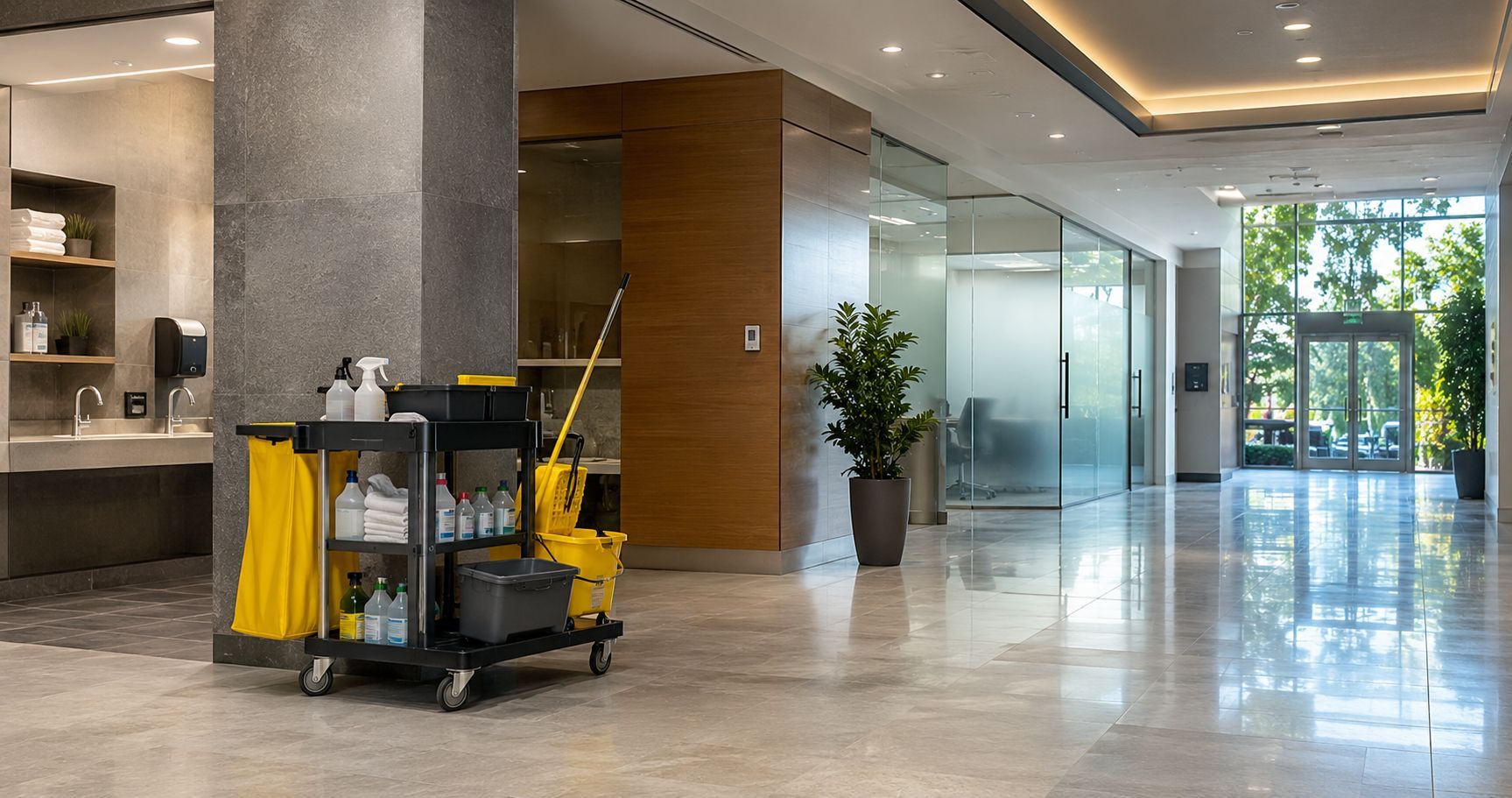
Quick Answer: Green cleaning in a commercial building is a complete operating program, not a single product swap. It combines cleaning chemistry that has been reviewed by a recognized third party, microfiber cloths and mops, vacuums with true HEPA filtration, measured dilution of concentrates, color coded tools that keep restroom and kitchen work separate, written procedures, and a crew trained to follow them on every visit. Labels such as EPA Safer Choice apply to individual products, while the Green Seal GS 42 standard looks at the entire cleaning service. A facility manager can tell a real program from a marketing claim by asking to see the product list, the equipment list, the training routine, and how results get checked.
A tenant on the fourth floor of an Oakland office building sends a short note to the property manager. The cleaners are fine, she says, but the whole floor smells strongly of something sweet and chemical by Tuesday morning, and two people on her team have started leaving their doors propped open. The property manager checks the janitorial contract and finds a line that says "green products used where available." That one phrase has to explain a product, a process, and a promise, and it does not do any of the three.
That gap shows up in buildings across the Bay Area, from San Francisco high rises to flex space in Hayward and medical suites in Walnut Creek. "Green cleaning" has become a phrase that every janitorial vendor uses and few define. For a facility manager, the useful question is not whether a vendor says green, but what a green program physically consists of on a Wednesday night when the crew arrives. This article walks through that, piece by piece, so you can recognize the real thing and write it into your expectations.
Green Cleaning Is a Program, Not a Product
Most people hear "green cleaning" and picture a spray bottle with a leaf on it. The bottle is one small part. A program has at least six working pieces: the chemistry, the tools, the dilution method, the technique, the training, and the checking. If any one of those is missing, the program is partly decorative.
Consider what happens when only the chemistry changes. A crew swaps in a certified all purpose cleaner but keeps using a loose cotton mop that smears soil around, a vacuum that blows fine dust back into the air, and a single cloth that moves from one surface to the next. The label on the jug says one thing, and the building experience says another. The program has to cover the whole routine for the results to hold.
This is also why the formal standards in the industry are written the way they are. The Green Seal GS 42 standard, for example, applies to the cleaning service itself and not only to what is in the bucket. It addresses how a provider manages products, equipment, staff training, and procedures across a commercial or institutional operation. That framing is a good model to borrow, even if your building never pursues a certification, because it reminds you to ask about the service and not just the supplies.
The Chemistry: What a Third Party Review Actually Means
Product claims on cleaning supplies are easy to make and hard to compare. Words such as natural, eco, and plant based have no shared definition, so they tell a buyer very little. A third party certification does the comparing for you.
EPA Safer Choice
EPA Safer Choice reviews product ingredients for safety and cleaning performance before approving its label. Products are evaluated ingredient by ingredient against established criteria for commercial, institutional, and household use.
Green Seal
Green Seal certifies products and services against its own standards. Buying certified products demonstrates responsible purchasing, while service certification evaluates how the vendor operates overall, including its cleaning practices.
What The Label Does Not Do
Certification does not make every product suitable for every job. A certified glass cleaner cannot replace floor stripper, and incorrect dilution remains improper use despite certification.
When you review a proposal, ask the vendor for the actual product list by name, grouped by task: restroom, glass, floor, kitchen, general surfaces. Then check which of those carry a recognized label. A real program can produce that list in an afternoon. A vague one produces a brochure.
The Tools: Microfiber, HEPA, and the Equipment Nobody Photographs
Ask any experienced crew lead what changed most about commercial cleaning over the past two decades, and the answer is usually the tools, not the chemicals.
Microfiber Cloths And Mops
Microfiber uses very fine synthetic fibers to physically capture dust and soil, reducing product use. Reusable microfiber mop heads also use less water than traditional string mops, making them central to many green cleaning programs for commercial facilities.
HEPA Filtered Vacuums
HEPA filtered vacuums capture fine dust instead of releasing it back into occupied spaces. They are especially useful in offices, schools, and other buildings with carpets and heavy foot traffic. Ask what filtration the cleaning crew uses before hiring.
Low Noise And Low Profile Machines
Green programs often favor quieter, low profile equipment, especially in medical offices, hotels, and occupied buildings. Lower noise allows cleaning during operating hours with less disruption, providing a practical benefit alongside the environmental advantages of efficient equipment overall.
Walk Off Mats And Entry Systems
Entry mats capture dirt before it travels across interior floors. Green cleaning programs recognize effective entry systems as important because much indoor soil arrives on shoes. Proper matting reduces tracked debris and helps preserve floors between cleaning cycles longer.
The Method: Dilution Control and Color Coding
Two process details separate a managed program from an improvised one, and both are invisible unless you know to look.
Measured Dilution
Commercial cleaners often arrive as concentrates. Metered dispensers mix them with water at a set ratio, keeping every bucket consistent. Proper dilution reduces waste, residue, odors, packaging, and the risk of ineffective cleaning across commercial facilities.
Color Coded Tools
A color coded system assigns tools to specific areas. Restroom cloths never touch break room counters. This simple separation prevents cross contamination, makes training easier, and gives supervisors a quick quality control check throughout busy buildings.
Technique
Good tools still require proper technique. Crews should work top to bottom and cleanest to dirtiest, allowing products proper contact time. Floors should receive damp mopping rather than excessive water during routine commercial cleaning tasks.
Tip: When you tour a building with a prospective janitorial vendor, look inside the janitorial closet. Labeled, color coded cloths, a dispenser on the wall, and a tidy cart tell you more about the program than the proposal does.
Training: Where Programs Succeed or Quietly Fail
A well designed program on paper becomes an ordinary program in practice when the crew does not know why the steps exist. Turnover in the janitorial field is a known challenge, which means training has to be built to survive it.
A working training routine usually includes a first shift walk through with a lead, a written or pictured task card for each zone, a refresher at set intervals, and a supervisor who checks work against the card and not against memory. New hires should know which product goes with which task, how the dispenser works, which cloth color belongs to which area, and why. A crew member who understands that the color system exists to keep restroom work away from kitchen surfaces will follow it on a night when no one is watching.
Ask a vendor three plain questions about this. How is a new cleaner trained before working alone in our building? How often is the routine refreshed? Who checks the work, and how often? The answers should be specific and should name a person or a role, not a general commitment to quality.
What a Green Program Does Not Mean
Because the phrase is so widely used, it picks up a few misunderstandings worth clearing up before they find their way into a contract.
It Does Not Mean Cleaning Less
It does not mean cleaning less. A properly run green program delivers the same visible cleanliness while changing how the result is achieved for occupants.
It Does Not Mean Skipping Disinfection Where Needed
It does not mean skipping disinfection where genuinely needed. Green programs can include registered disinfectants when facility protocols require them on specific surfaces and areas.
It Does Not Guarantee Health Outcomes
It does not guarantee health outcomes. Green cleaning can reduce unnecessary chemicals and dust, but providers should not promise fewer illnesses or sick days.
It Does Not Mean One Product Line
It does not mean one product line. Different surfaces require different methods, so green programs match tools and products to each surface’s specific maintenance needs.
Writing Green Cleaning Into Your Scope
A green program works best when it appears in the scope of work as specific expectations, not as an adjective. A scope that says "green cleaning services" invites different readings. A scope that lists the pieces gives everyone the same checklist.
Useful items to name include the following.
Product Standards
Require recognized third party labels where available, plus updated product lists whenever products change or are requested.
Equipment
Specify microfiber dusting and mopping tools and HEPA filtered vacuums. Include quiet equipment requirements for occupied hours.
Dilution
Require concentrates to be mixed through metered systems rather than manually, ensuring consistent dilution throughout cleaning operations.
Color Coding
Define cleaning zones clearly and require the vendor to confirm its color coding system in writing.
Training And Supervision
Request training procedures and inspection schedules, then establish how cleaning results will be documented and reviewed.
Entry Matting And Floor Care
Include mat service and entrance floor protection within the cleaning scope, preventing confusion about responsibility for these tasks.
If you are building a full scope from scratch, our earlier guide on writing a
commercial cleaning scope of work covers how to map zones and attach frequencies to each task, and the green program items above fit naturally inside that structure.
How to Check That the Program Is Real
Words in a proposal are easy. Evidence in the building is harder to fake, and a few simple checks give you a reliable read.
Review The Closet And Cart
Check for labeled dispensers, color coded cloths, and clean equipment. Unlabeled spray bottles indicate poor organization and control.
Ask For The Product List
Compare the product list with supplies on shelves. Names should match exactly, confirming products are being used as documented.
Walk The Building During Service
Observe the crew during one service shift. Watch their sequence, cloth usage, equipment, and vacuuming methods without needing technical expertise.
Notice The Building, Not The Cleaning
Look for residue free surfaces, clean floors, and neutral air. Sticky floors or strong odors often indicate dilution or technique problems.
Request A Simple Inspection Routine
Ask supervisors to use checklists during building inspections and share results. Documentation makes vendor discussions objective, specific, and easier to resolve.
Warning: Mixing cleaning products by hand or topping off a bottle with a different product can create hazards and ruin the finish on a surface. Crews should use only the product and the dilution method assigned to each task.
Frequently Asked Questions
What is the difference between green cleaning and regular commercial cleaning?
The tasks are often the same, but the method differs. Green programs use certified products, microfiber tools, HEPA vacuums, measured dilution, color coded cloths, and trained staff. The visible standard of cleanliness should be at least as high.
Does a green cleaning product work as well as a conventional one?
Certified products are reviewed for performance as well as ingredients. Results still depend on the right product, dilution, and tool for each surface. A good product used poorly can look worse than an ordinary one used well.
What certifications should I ask a janitorial company about?
Start with EPA Safer Choice for products and Green Seal for products and services. GS 42 covers the full cleaning service. Some owners also follow LEED cleaning credits. Request documentation for any claim.
Can green cleaning be used in medical offices and other sensitive spaces?
Yes, with care. A green program can sit alongside defined disinfecting protocols when the scope states which surfaces get which treatment. Match the vendor's approach to your facility's own requirements.
How do I know a vendor is not just using the word green as marketing?
Ask for specifics. A real program can name its products, show its vacuums and cloths, explain dilution, and describe training and inspection. Vague answers usually mean a vague program. A closet walk settles it.
Should green cleaning requirements go in the contract?
Yes. Write them into the scope as specific items: product standards, equipment types, dilution method, color coding, training, and inspections. Naming each piece gives both sides the same checklist.
A Real Green Program Shows Up on Site
A green cleaning program is not a single product swap, and the building tells you whether it exists. Certified chemistry, microfiber tools, HEPA filtered vacuums, metered dilution, and color coded cloths all work together, supported by written procedures and a trained crew. When the closet is tidy, the product list matches the shelf, and the floors carry no film, the program is doing its job. Specific scope language turns a vague adjective into a checklist that both sides can follow.
With 26
years of experience serving Walnut Creek, CA, Skyline Building Care
has seen how much a documented routine helps property managers answer tenant questions with confidence. Training that survives crew turnover, steady supervision, and honest inspection records keep standards from slipping between visits. When those pieces stay in place, the building simply feels clean, the air stays free of strong chemical odors, and tenants can focus on their work instead of on the cleaning.